Kenyan Sustainable Yarn
Sonia Weill
THE PROBLEM (INQUIRE)
Throughout the past few decades, both microplastics and yarnwork-based businesses have become increasingly prevalent across the globe. Spurred by social media and an increased availability of yarn, crocheting and knitting have seen a resurgence not only in the United States, but here in Kenya as well. Unfortunately, this easily-accessible yarn is often made of a material detrimental to both our health and planet: acrylic. Unknown to most, the yarn textile artists work with every day, as well as the hand-knit or crocheted clothes we wear, can release harmful microplastics into our air and water. Though it’s difficult to find studies or statistics on the effects of microplastics emitted from plastic yarn in Kenya, the Plastic Soup Foundation explains that a third of the floating dust we breathe in is made up of microplastics released by synthetic textiles. Throughout this project, I investigate a lack of access to sustainable textiles in the context of Kenyan artisans, with a focus on crochet, knitting, and other yarnwork-based local entrepreneurs or hobbyists, and attempt to design a solution to the issue. Any solutions drafted address the problem at a grassroots scale, as reducing the wider imports of acrylic yarn is more of a problem geared towards an economic viewpoint. Yarnwork has been a passion of mine for half my life, and it was devastating to learn that my hobby could cause so much environmental and social damage. The earth shouldn’t have to suffer in order for us to do the crafts we love.
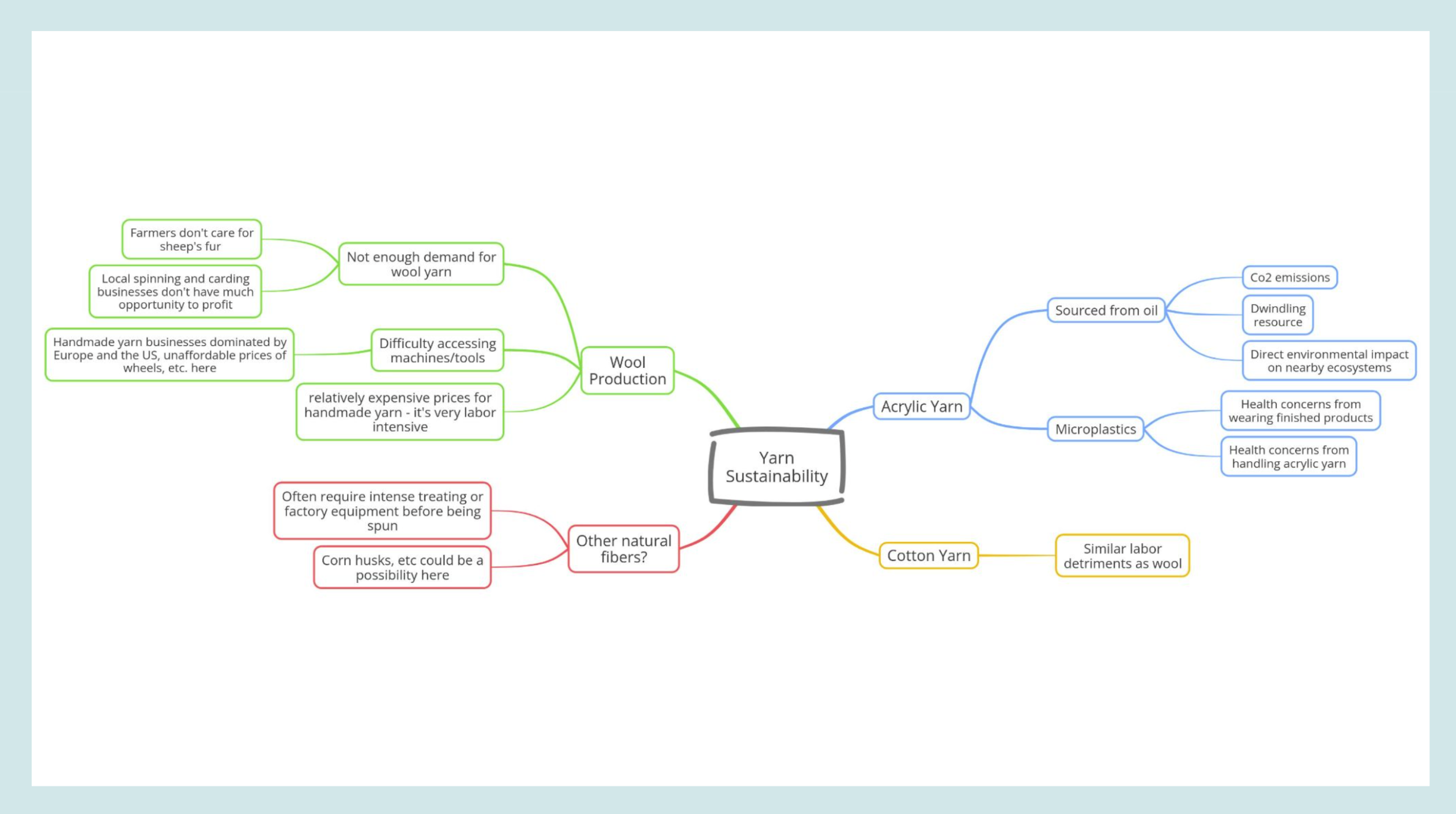
A mind map of yarn sustainability issues in Kenya.
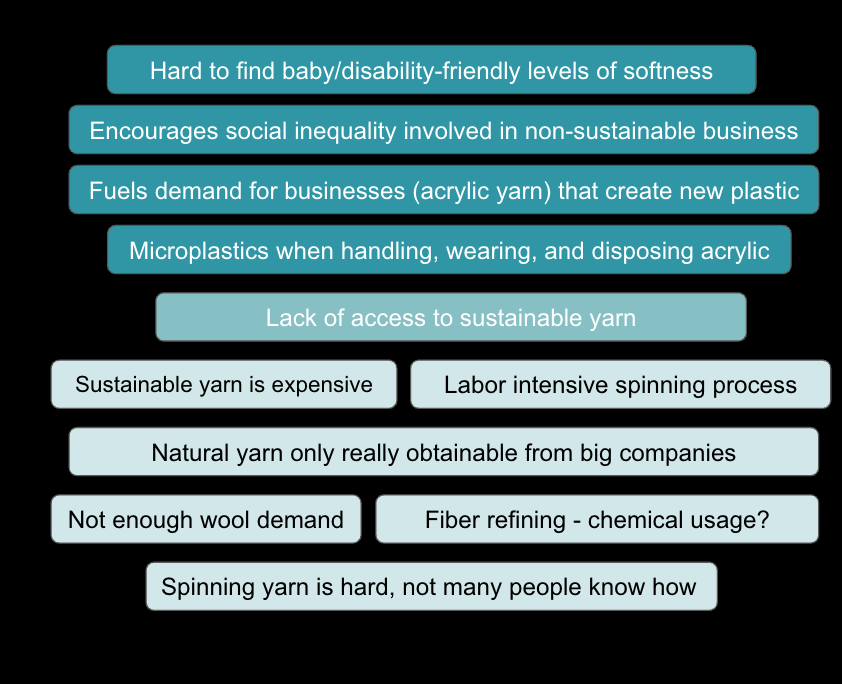
A problem tree for yarn sustainability issues in Kenya.
The current system surrounding acrylic yarn not only poses environmental issues, but also social and economic challenges. As such, I’ll conduct an analysis of each stage of the product’s life cycle:
1. Extraction
Acrylic yarn is made of oil manufactured into polyacrylonitrile, the acquisition of which disrupts and poisons ecosystems (eia.gov). Harmful chemical dyes and stabilizers are also manufactured to make this yarn. Furthermore, oil extraction often results in environmental damage with little or no compensation to those whose livelihoods are disrupted. Finally, though this sentiment is fairly common, it warrants restating: oil is not renewable. We’re running out, and any profits made by acrylic yarn now will be severely reduced when oil becomes scarce. Change needs to happen for this product to be economically stable.
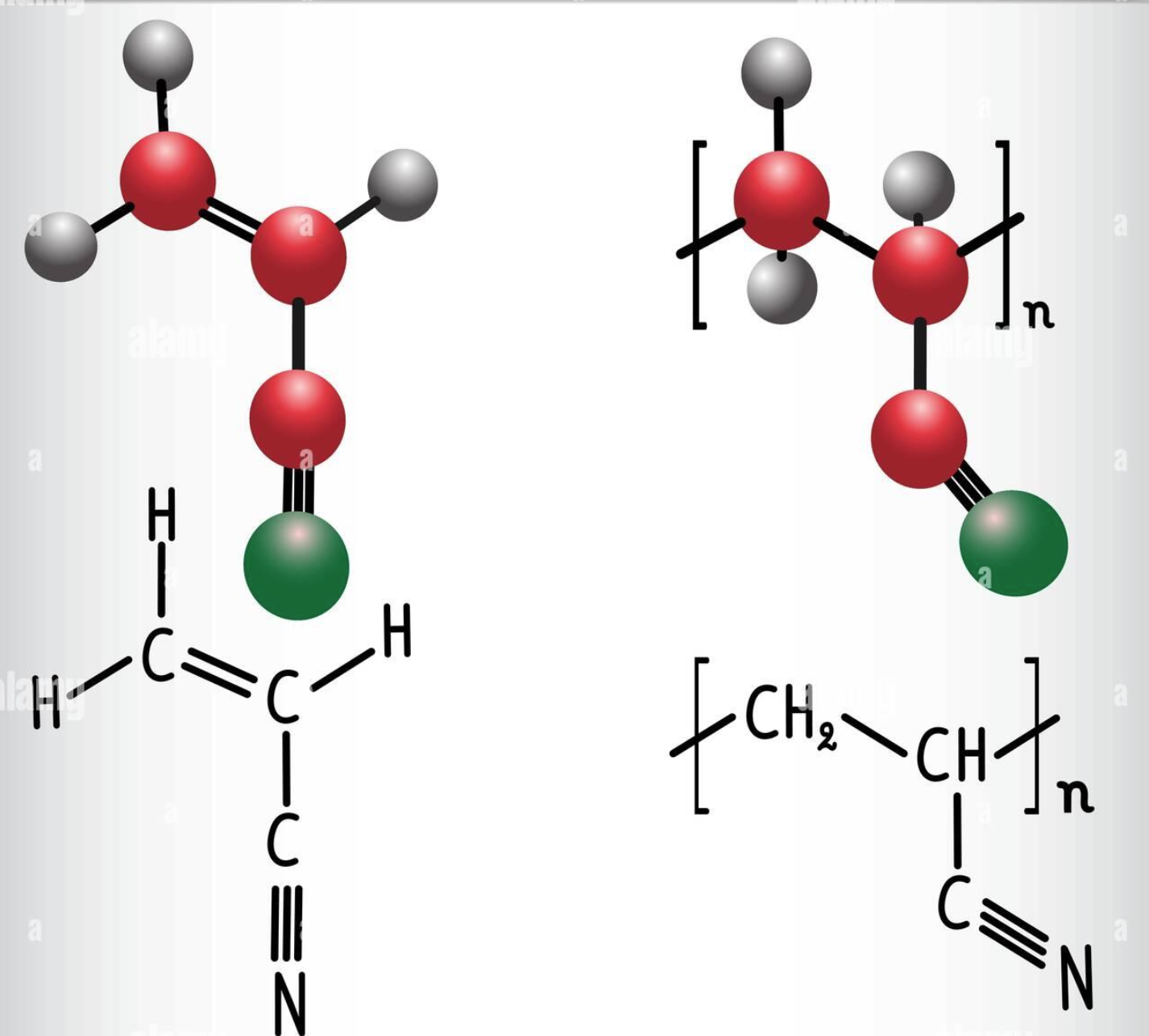 Acrylonitrile (left) and polyacrylonitrile (right). Source credits: Alamy.
2. Production
Acrylic yarn factories present a host of environmental issues: dye and stabilizer runoff can pollute nearby environments, microplastics and other fumes can poison the air, and the power consumed throughout the whole manufacturing process is not typically derived from renewable sources. Sparrow Fashion highlights the social impact of acrylic yarn manufacturing as well – factory workers with prolonged exposure to the chemicals involved in this process are often at a higher risk of contracting health issues. While not directly related to acrylic yarn, it’s important to note that any homespun, more sustainable variety comes with its own labor costs. It can take hours just to spin one skein of yarn, which is part of the reason so many fiber artists use yarn manufactured on a large scale today. From an economic standpoint, acrylic yarn is actually quite cost-effective; it’s incredibly cheap to manufacture in comparison to other textiles. Plastic fibers are easy to mass-produce and spin into yarn, with little of the high labor cost associated with wool or cotton.
3. Transportation
Yarn in Kenya comes primarily from India and Indonesia. These long cargo-ship journeys or plane flights release literal tons of CO2 into the atmosphere. Cargo boats can additionally cause severe damage to marine ecosystems like coral reefs or kelp forests. Socially, shipping over water can result in heavy noise pollution that’s harmful to operators’ hearing and health, and can disrupt the economies and environments of coastal towns in Kenya. Economically, while transportation is not too costly (India is relatively close to Kenya), production within the country itself would be much cheaper, and fewer transportation costs would be required.
4. Utilization
Supporters of this textile might point out that acrylic yarn typically creates more durable products than yarn made from other materials; however, as aforementioned, acrylic yarn releases microplastics throughout its entire lifecycle. Washing clothes made from synthetic fibers can pollute our water, wearing them can pollute our air, and handling the yarn itself does so, too. Acrylic yarn does have a couple of redeeming qualities, though: it’s easily accessible to everyone regardless of wealth or social status and grants people the opportunity to form a lifestyle around knitting and crocheting businesses. The fiber is easy to wash, take care of, and use. As a plastic, it can take on the vibrant colors that so many fiber artists enjoy using in their work. This results in a high demand for the product, and has contributed to the economic sector’s rapid growth. Unlike the labor-intensive cotton, wool, and bamboo yarns, acrylic is widely affordable. Nonetheless, it’s still a double-edged sword where accessibility and convenience come hand in hand with poison.
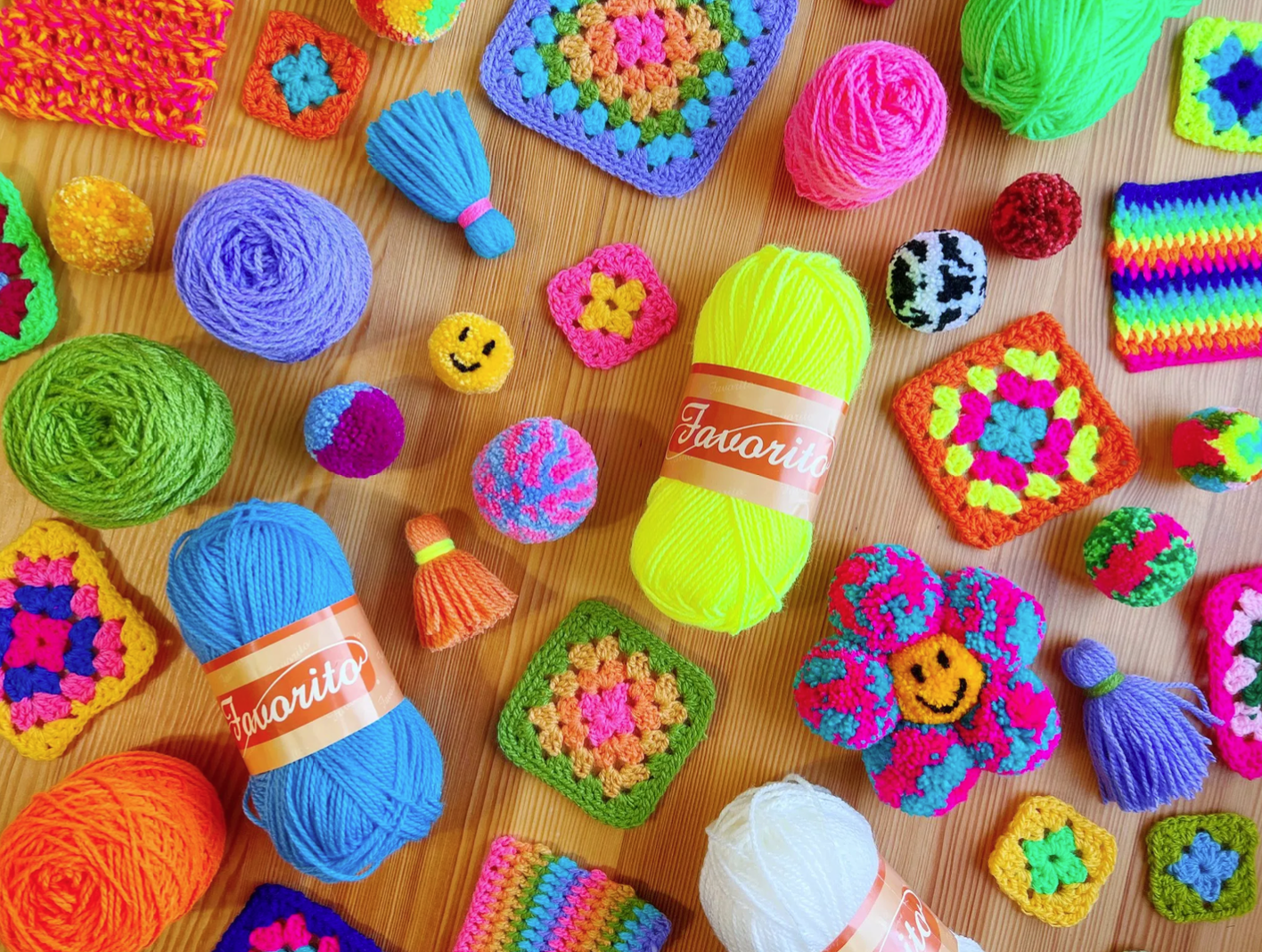 Fig3. Acrylic yarn comes in vibrant colors. Source credits: The Neon Tea Party.
5. Disposal
Disposal is one of the key issues with this product – polyacrylonitrile does not decompose. Instead, it breaks down into more microplastics. The average human already has a spoon’s worth of microplastics inside their brain, babies are being born with microplastics in their tissues, and it pervades the air we breathe. Rather than producing more products that perpetuate this issue, our focus should be on creating sustainable and healthy alternatives. Furthermore, there’s not really any widely accessible system to recycle acrylic yarn. Yarn artists themselves can frog (unravel) projects, swap scrap yarn, and create stash-busters (projects that utilize short lengths of waste yarn), but it’s nearly impossible to recycle the plastic itself into new yarn in Kenya. This also results in economic loss, as the expenses of raw materials wouldn’t be required for recycled yarn production.
Many of the major stakeholders involved, namely yarn production companies, acrylic yarn importers/exporters/vendors, yarnwork-based businesses, and fiber artists/hobbyists, are largely unaware of the detriments of acrylic yarn. Even if they are aware and wish to be more sustainable, financial obstacles (as seen above) make it extremely difficult. Yarn production companies believe that they’d be remiss to abandon such a profitable enterprise, and crocheters/knitters/weavers are loath to give up economic and easy-to-work-with materials in favor of wool or cotton yarn. However, there’s a growing movement of textile artists trying to use only environmentally-friendly products in their projects.
Within the analysis above, some major pain points on yarn sustainability are identified: acrylic yarn is currently the only affordable option for Kenyan fiber artists. It’s not sustainable in the least, and Kenyans have little or no way to recycle scraps. Finally, any process to create yarn is currently incredibly labor-intensive, discouraging crocheters/knitters/weavers from attempting to create their own materials. Overall, this can be boiled down to one clear gap: yarn-users have no way to easily access alternatives to acrylic yarn, a material that has extreme environmental, social, and economic detriments.
DEVELOP
In order to develop a solution to this issue, I used several models to analyze and brainstorm. The first was a SCAMPER model, designed to allow for quick questions and idea generation:
|
Substitute: Replace the main topic with a similar idea |
Instead of traditional yarns (acrylic, bamboo, cotton, wool), could we use materials more prevalent in Kenya (eg. corn husks, sugarcane bagasse)? |
|
Combine: Combine the original topic with additional information |
Could the process of yarn manufacturing be combined with some other waste-disposal process, taking otherwise useless materials and turning them into yarn? |
|
Adapt: Adjust the issue with alternative design options |
Instead of targeting yarn at its use and production stages, could we target it at the disposal stage and try to introduce yarn recycling somehow? |
|
Modify: Change the topic with creative solutions |
What if we stop using yarn and replace it with some other fiber or cord entirely? What if we make a new bioplastic to make yarn from? |
|
Put to another use: Identify possible scenarios where the topic can be used |
Any solutions to yarn production might be able to apply to thread, cord, or rope production as well. Similarly, inspiration could be drawn from sustainable innovation in these areas and applied to yarn. |
|
Eliminate: Remove features that don’t offer enough value |
Skeins are wrapped incredibly inefficiently. If people stopped spinning yarn cakes and wrapping them in plastic or paper/plastic, there’d be much less of an environmental impact. |
|
Rearrange: Reverse and rearrange the problem to come up with a new concept |
Rather than the yarn production itself, the problem might lie in the acquisition of materials for alternatives to acrylic yarn. Maybe a solution to help maintain the quality of sheep’s wool or split fibers from bamboo would be more effective. |
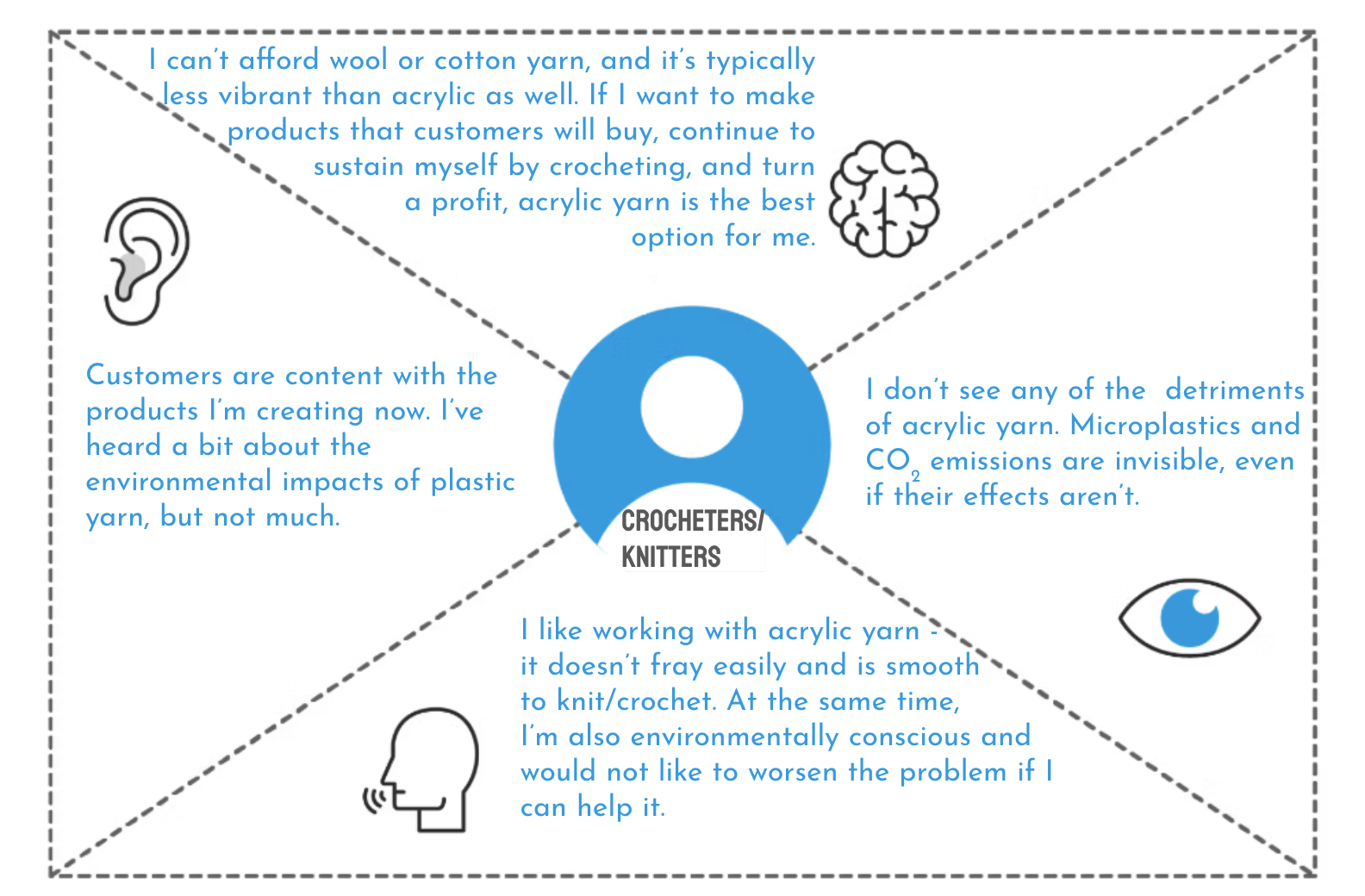
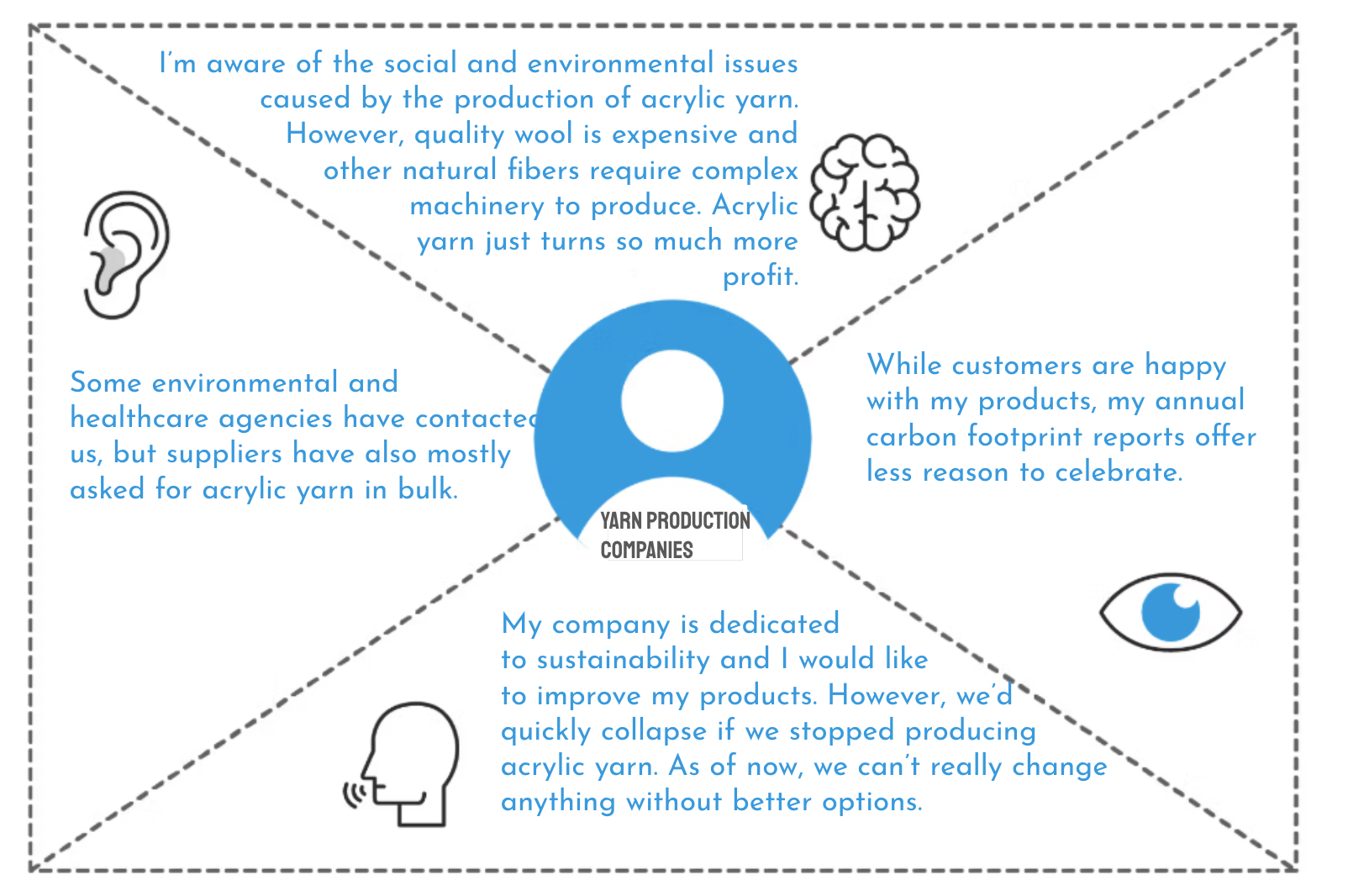
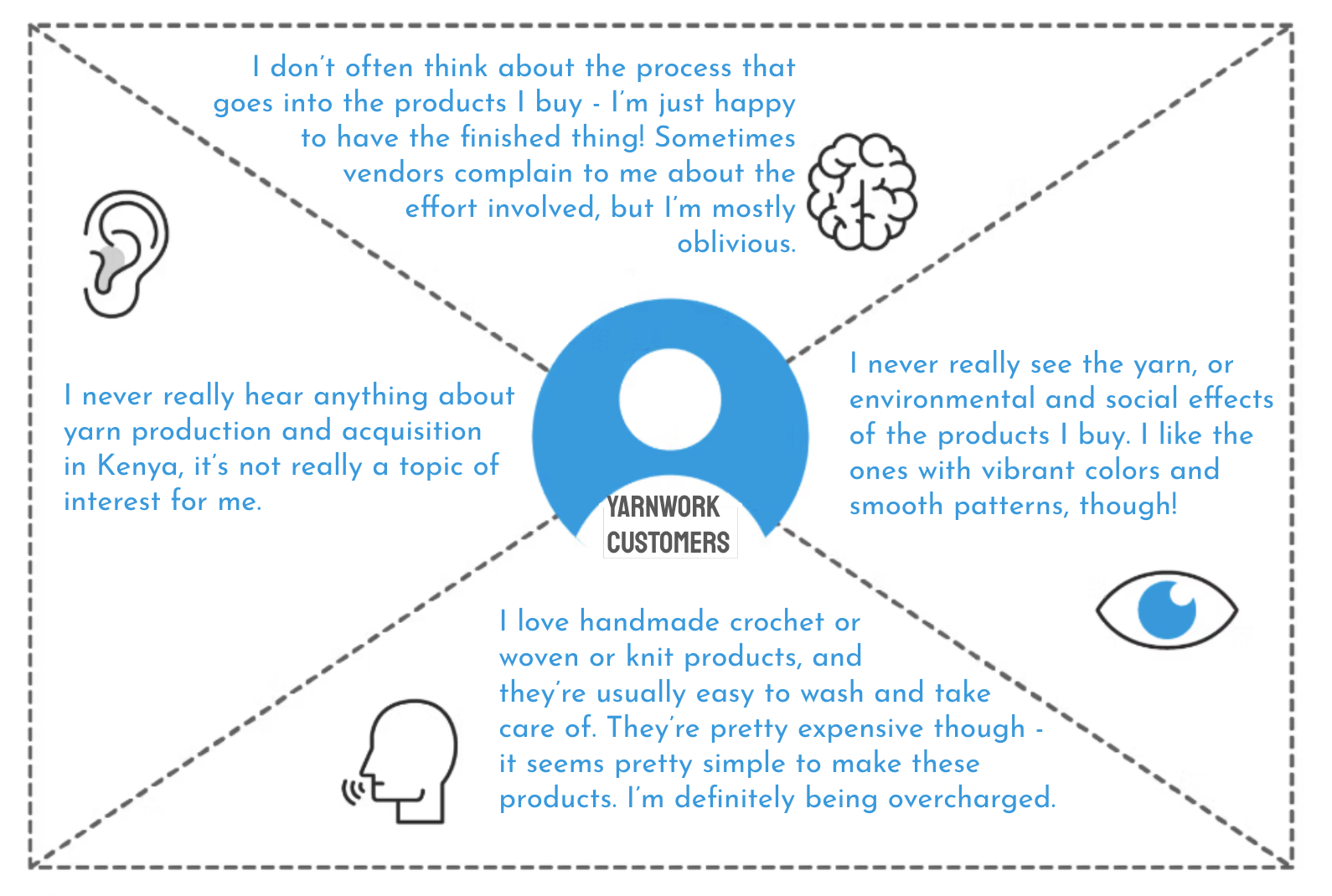
Next were empathy maps. I asked myself how different individuals involved in the process would view the issue, and created maps of their perspectives:
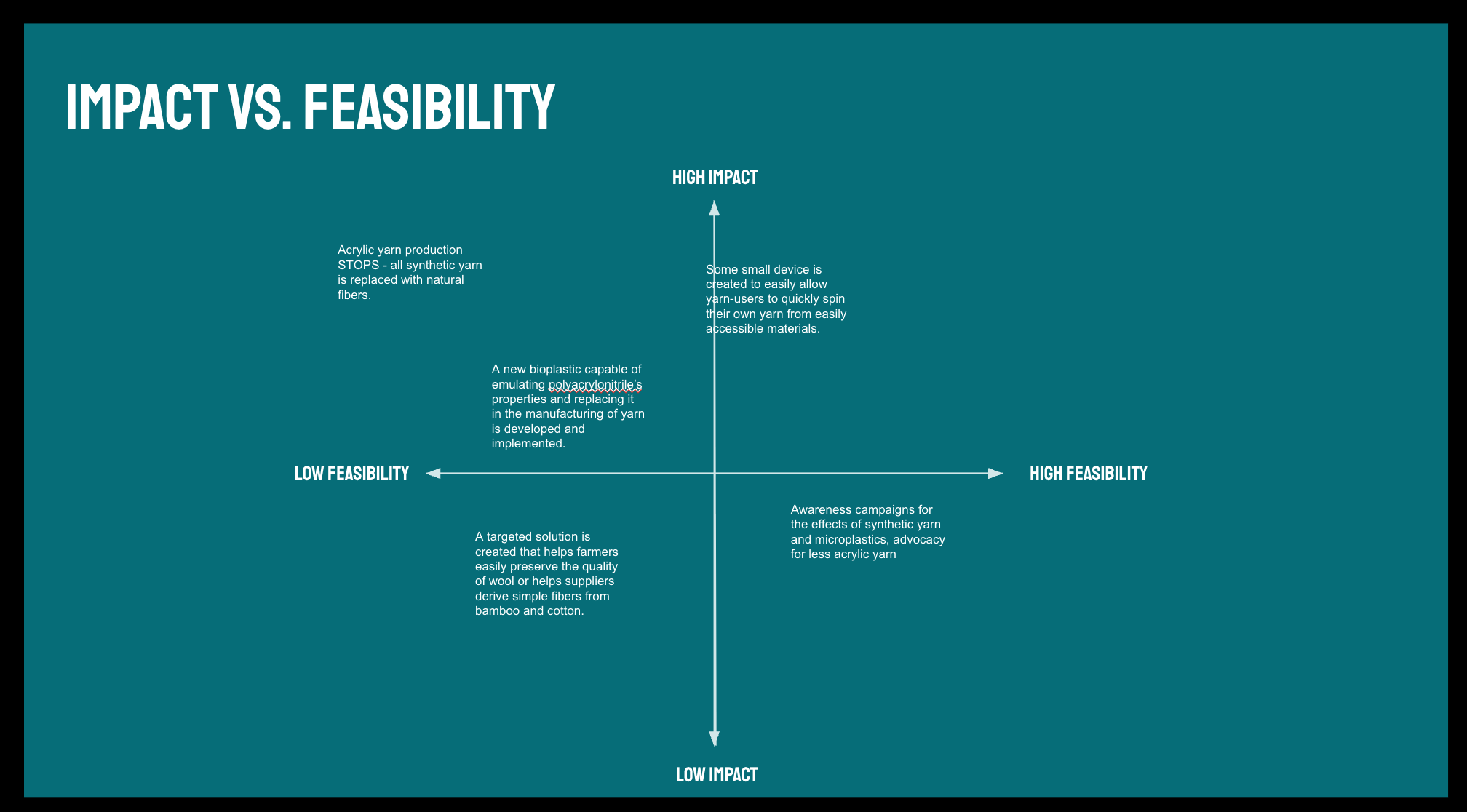
From these preliminary brainstorming exercises, I outlined five potential solutions to the issue of yarn sustainability in Kenya, ranging from high-impact but entirely infeasible to lower-impact but more realistic:
1. Acrylic yarn production stops – all synthetic yarn is replaced with natural fibers.
This proposal is highly unrealistic. Banning all acrylic yarn is impossible as an individual and would even be extremely difficult on a governmental level. It would reduce microplastics, yes, but it would also eviscerate the textile industry in Kenya and run local crochet, weaving, or knitting endeavors out of business. Environmentally, this would be progress. Socially and economically, it would be a disaster. This solution is high impact, low feasibility, and unfavorable overall.
2. A new bioplastic capable of emulating polyacrylonitrile’s properties and replacing it in the manufacturing of yarn is developed and implemented.
While this proposal would reduce acrylic use and replace the material with an alternative, I just can’t see it being economically sustainable. Manufacturing and developing bioplastics is a lengthy and sometimes costly process, and the durability of products made from a new polymer would be difficult to guarantee. However, it does present the attractive option of using some other industry’s waste products to create the bioplastic, solving two issues at once. This solution is high impact, low feasibility, and fine in terms of effectiveness.
3. A targeted solution is created that helps farmers easily preserve the quality of wool or helps suppliers derive simple fibers from bamboo and cotton. While not as damaging as polyacrylonitrile, agricultural yarns still require immense amounts of resources to manufacture. Water usage, pesticides, and deforestation are all environmental issues that come hand in hand with so-called “sustainable” yarn alternatives. Moreover, the process of refining these natural fibers would still be either greatly industrial or labor-intensive, even with something to streamline the process. Finally, it’s very unlikely that the same cost-effectiveness and availability that acrylic yarn has today would be able to be achieved with resources that farmers put effort into growing. Additionally, I doubt any Kenyan farmer would be fully open to changing processes that have worked for them for years. It would be ideal to target the problem in its manufacturing stage, but this is not the solution. This option is low feasibility, low impact, and unlikely to be implemented.
4. Awareness campaigns for the effects of synthetic yarn and microplastics, and advocacy for less acrylic yarn. Firstly, this idea offers little opportunity for a solution to be designed. However, it would be fairly easy to establish and support over time. Socially, this solution might actually have the highest impact. Nonetheless, there’s still no assurance that people would take action after learning about the environmental effects of acrylic yarn, and no economic motivation for it to be carried out. Overall, this solution is high feasibility, low-impact, and not exactly suited for this project.
5. A small device is created to easily allow yarn-users to quickly spin their own yarn from accessible materials.
Of all the proposed solutions, this one is my favorite. Not only does it provide the opportunity to go through the design process, but it also seems to be a reasonable mix of impact and feasibility. Though it might be difficult to actually create, this solution would, in theory, be extremely effective at a grassroots level – there’d be no demand for harmful plastic fibers if people could make their own yarn. It could make use of waste products or invasive species and thus help the environment rather than harm it. Additionally, there’d be little cost involved, and it’d be accessible to most who’d need it, though it would still be able to sustain itself economically. This solution is moderately feasible, high-impact, and well-suited for this project.
After selecting option 5 as my preferred method of designing a solution, I outlined my design constraints and drafted three initial sketches:
|
Target Audience |
Targeted towards local hobbyists, thus must cost less than $25 Easily understandable: the average person must be able to operate it after reading a manual of no more than 300 words |
|
Aesthetics |
Visually appealing: have at least two colors, rated as “would buy it if I needed it” by at least 50% of people asked. |
|
Function |
Able to card and/or comb dried natural fibers Able to spin various natural fibers Adjustable for different sizes and variations of yarn/twine produced Be hand-operated (not reliant on electricity) Able to be continuously operated by the average person for at least five minutes Efficient: no more than 1.5 hours per bobbin of yarn/twine produced |
|
Production Constraints |
Locally manufactured. |
|
Material Selection |
Made only of waste material (eg, scrap wood, aluminum cans) |
|
Size |
No larger than 16” by 12” by 12” (preferably much smaller, so it can fit conveniently on a table) |
|
Environmental Considerations |
Repairable by the average user when predicted failures occur, at little cost to them (less than $5) Disassemblable into each component/material for recycling/reuse, in less than 20 minutes (when broken beyond repair) |
|
Safety |
Unable to cause unintentional injury to a user from sharp edges, pressure, fingers getting caught, or loose components |
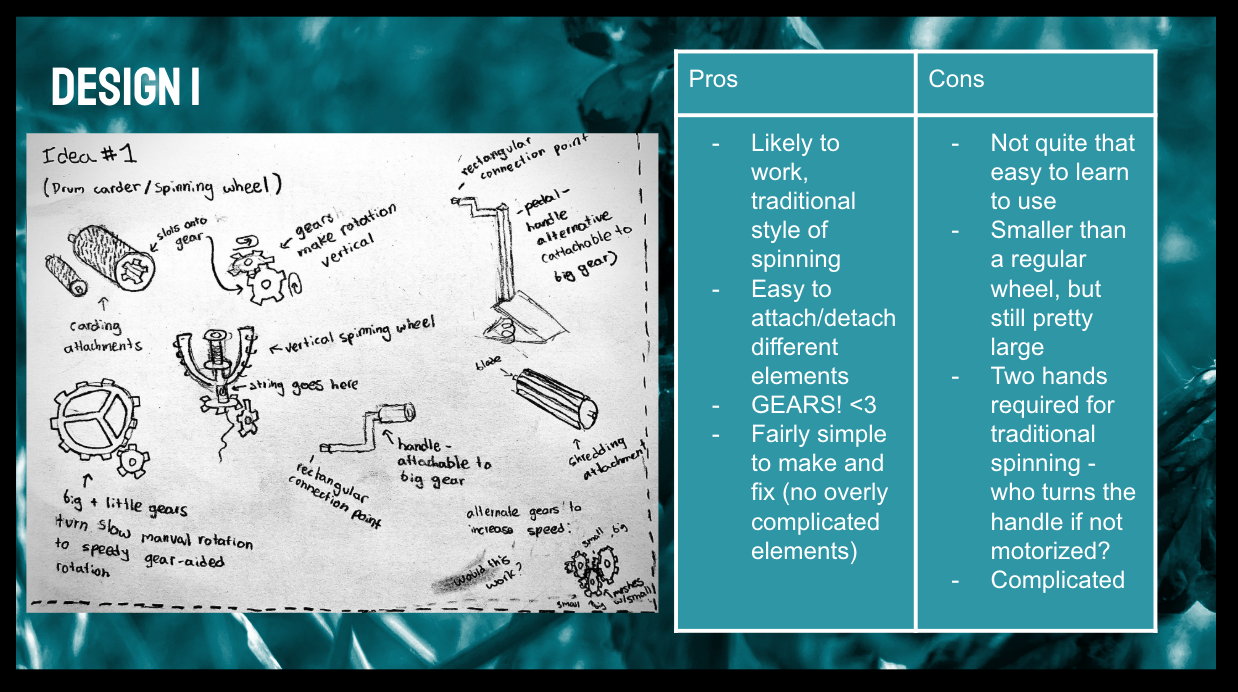
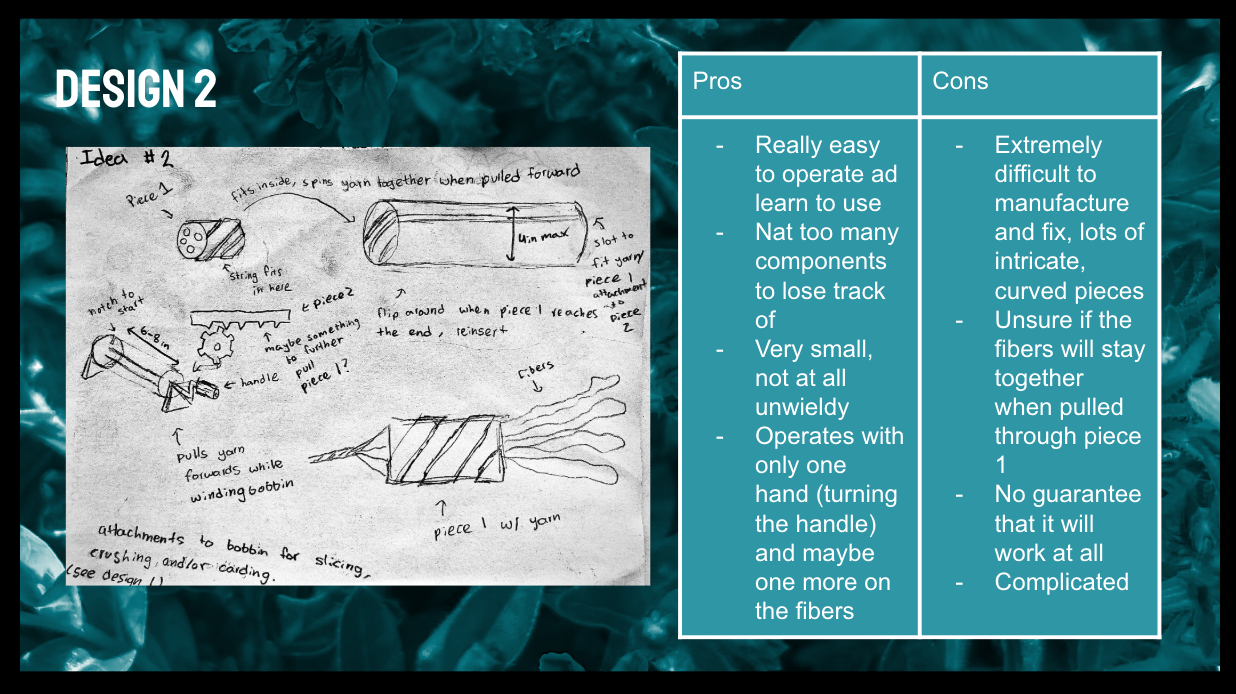
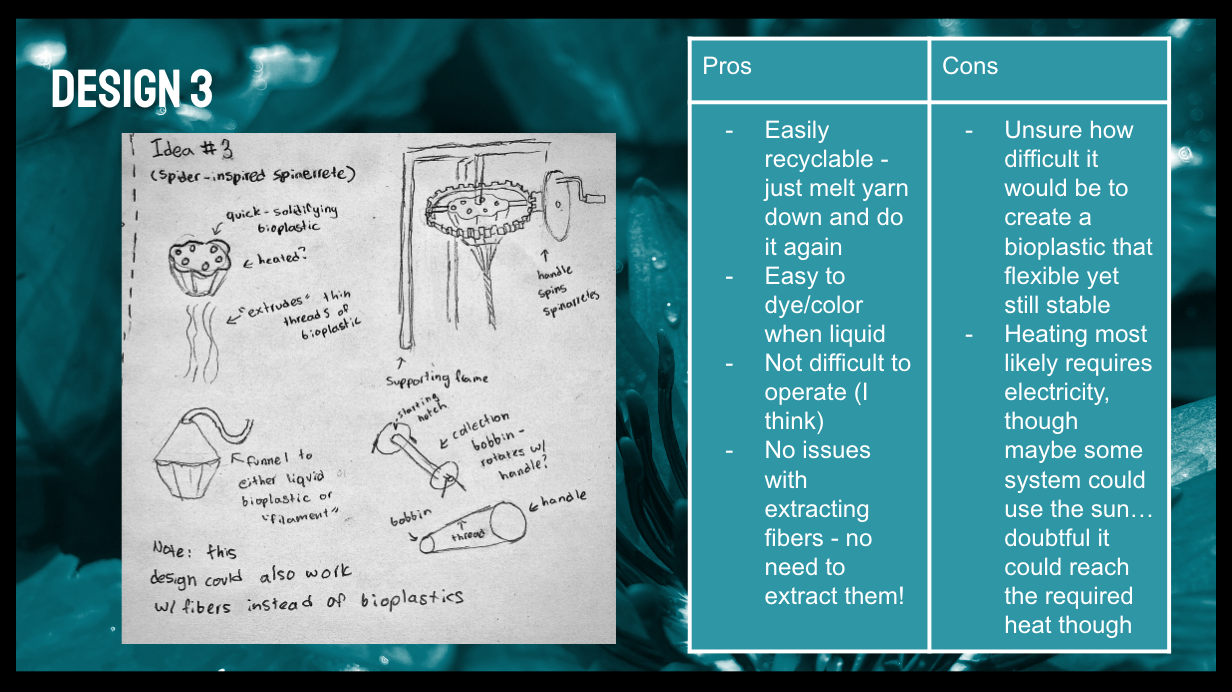
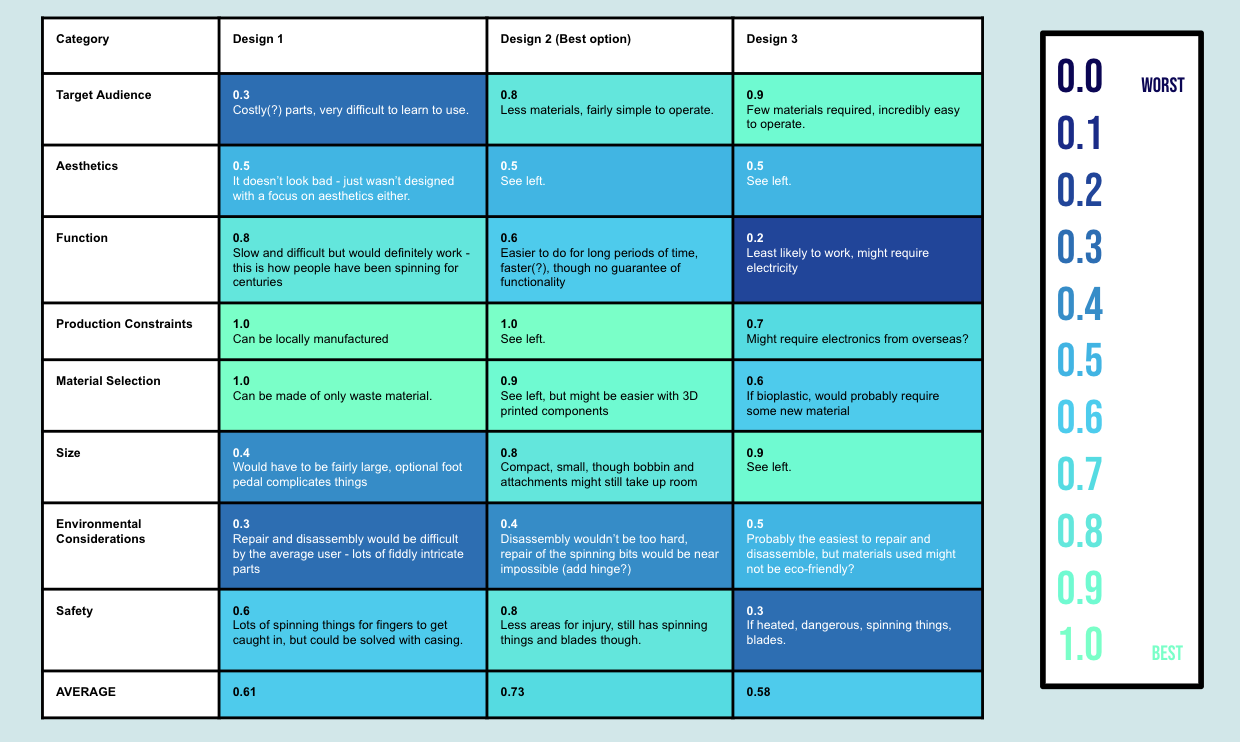
I then evaluated all three sketches and found design 2 to be the best option. The first sketch was the most conservative, preserving a spinning wheel’s original shape and function while adding on attachments for carding and separating fibers. It was the most likely to work as intended, but also the most difficult to operate. The second sketch would be easier to operate (as any fibers would both be spun and move forward on their own), though less likely to work, and the third sketch was the most extreme. The process proposed in the third would require no more human involvement than turning a handle, but it was highly unlikely to function. In the interest of balancing ease of use and functionality, I decided to develop the second idea:
CREATE/EVALUATE
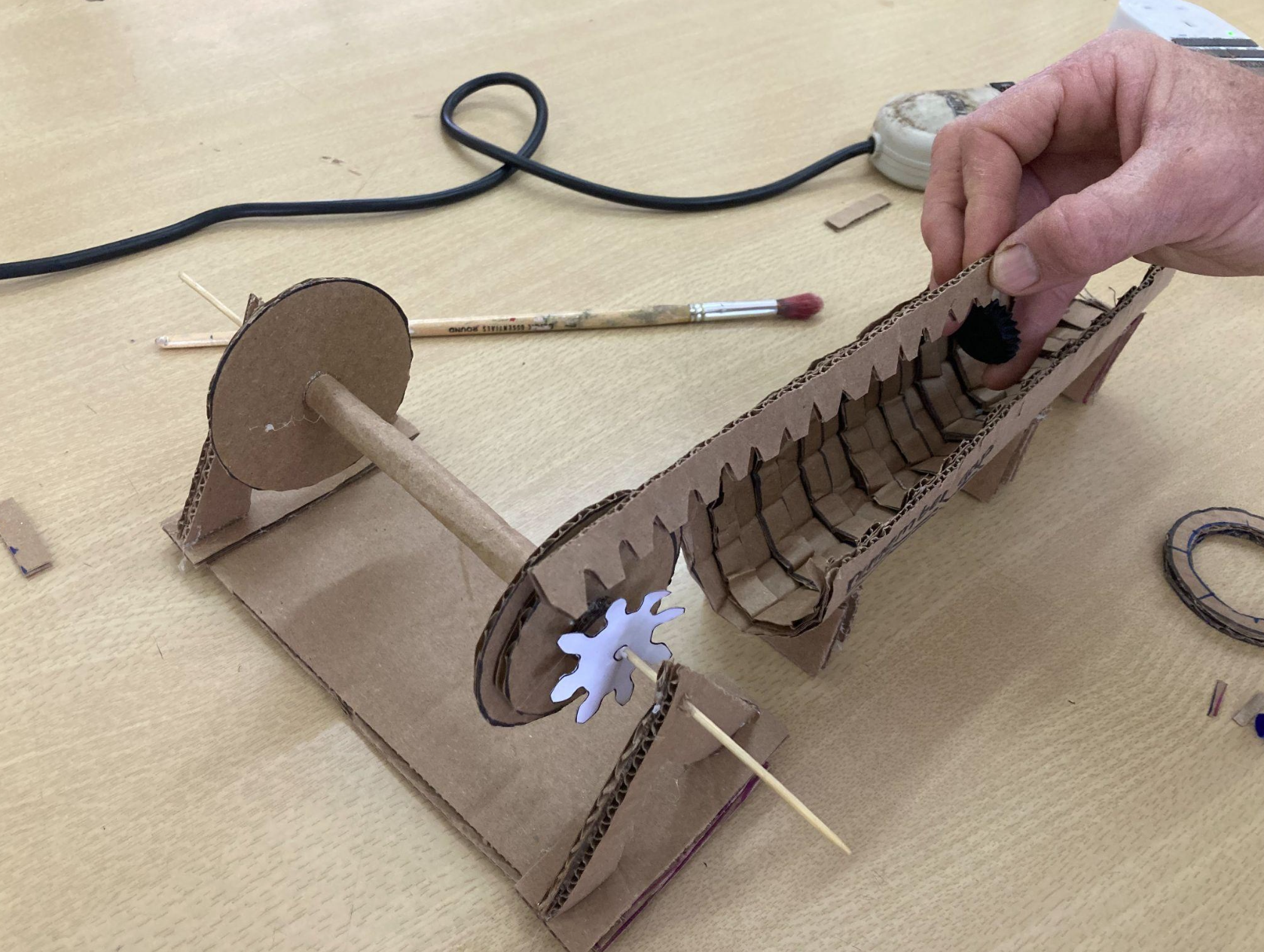
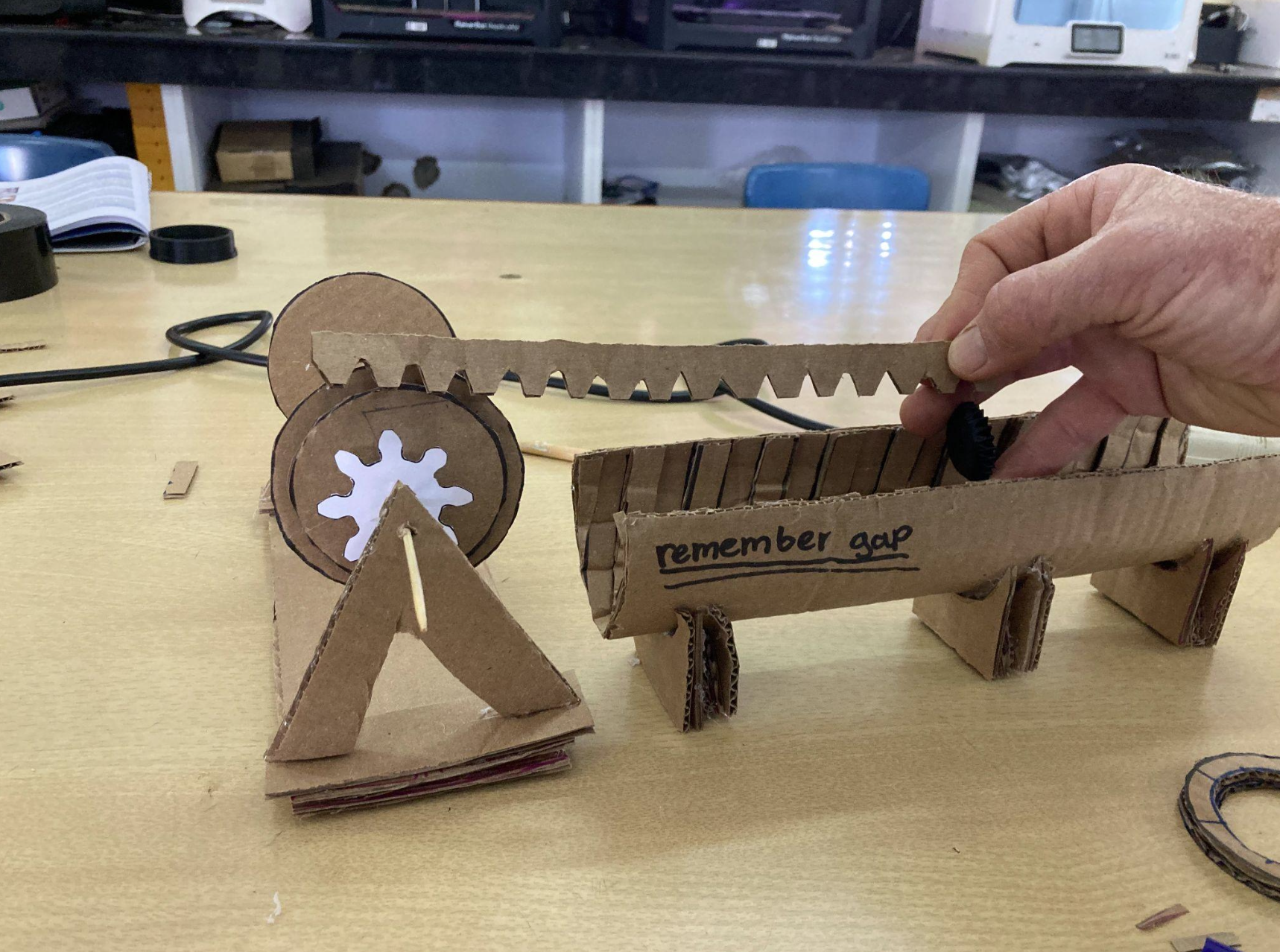
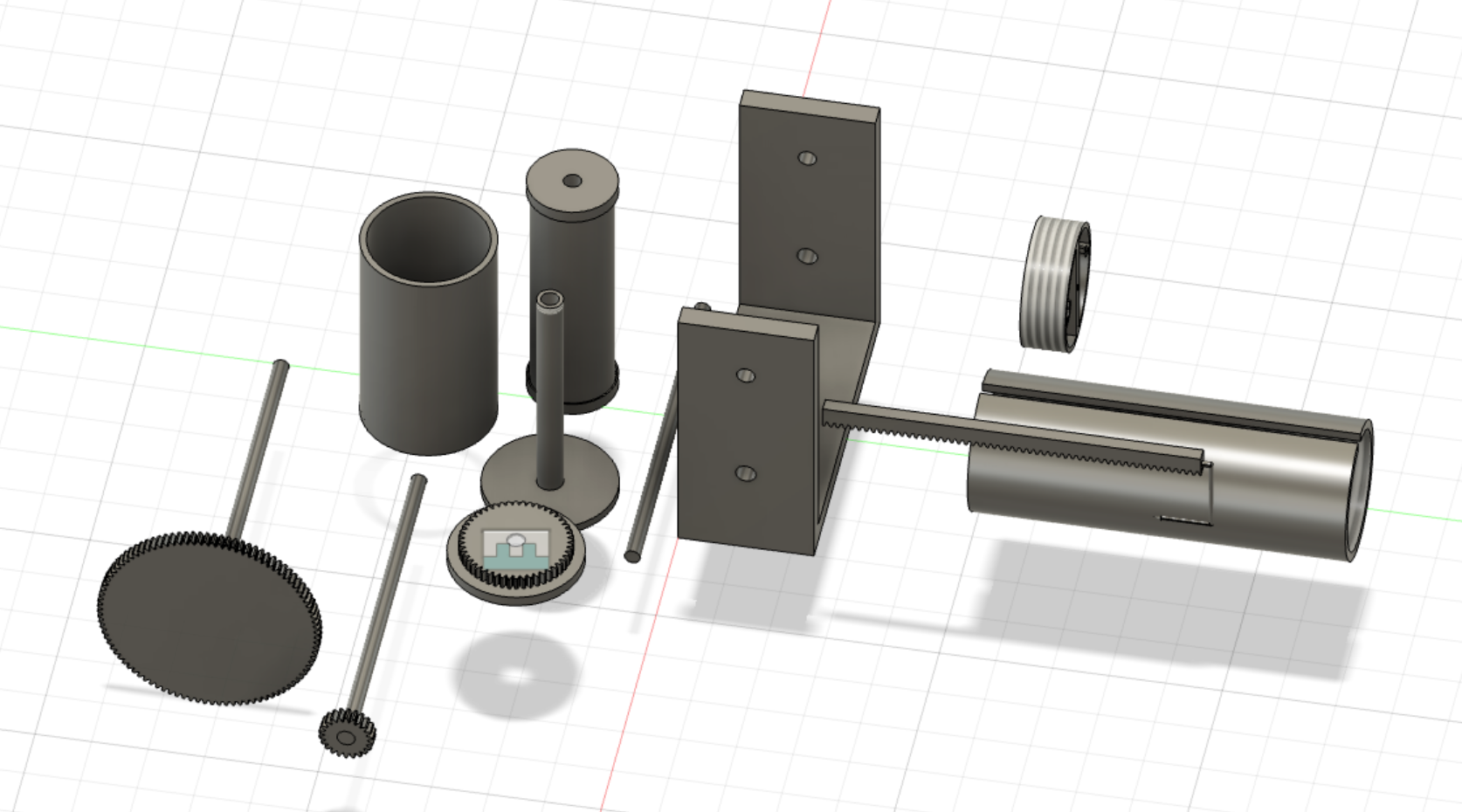
After deciding upon the second idea as my chosen design, I created a cardboard model, then an improved 3D model on Fusion 360. Both models are shown below:
Prototype #1:
Prototype #2, deconstructed for 3D printing:
Prototype #2, assembled:
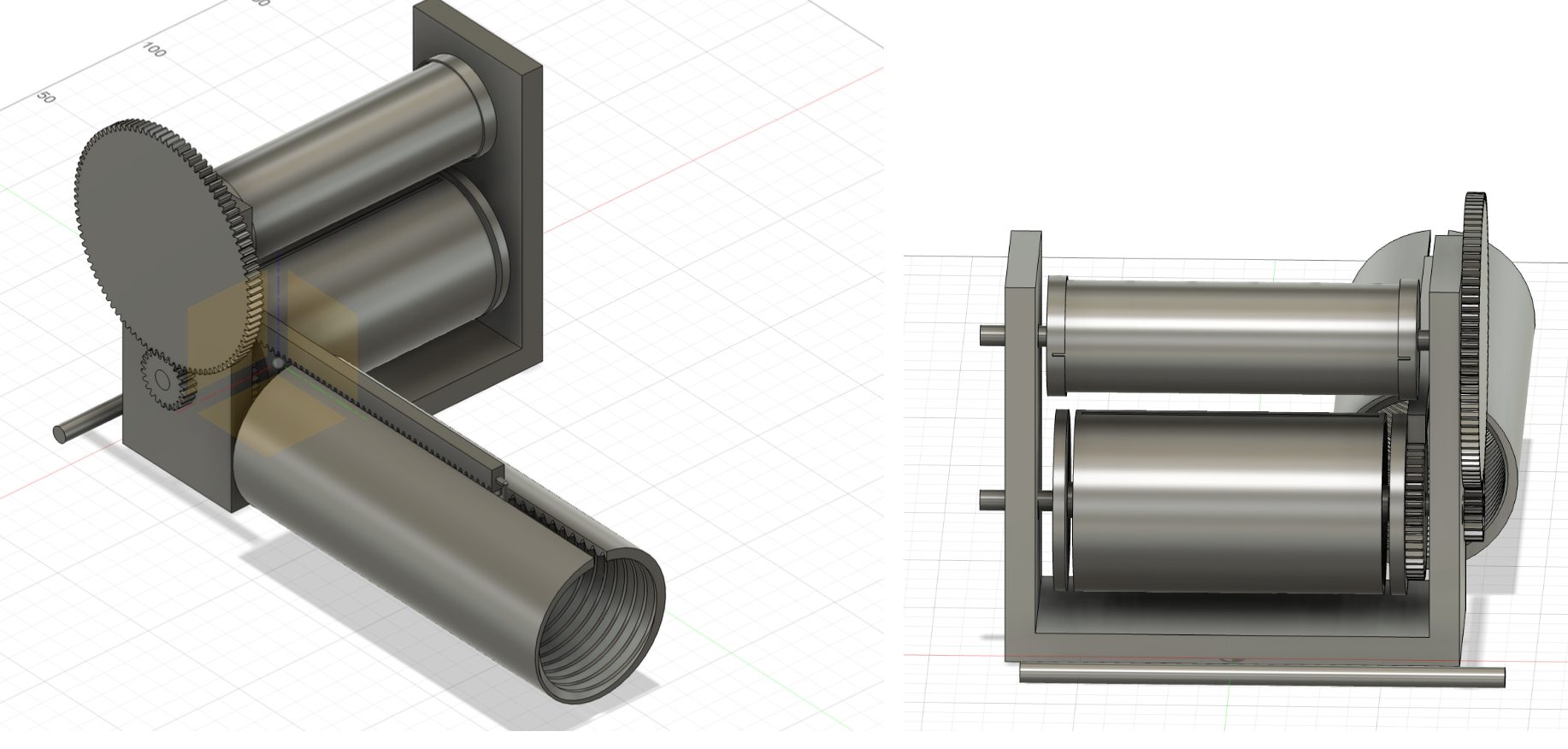
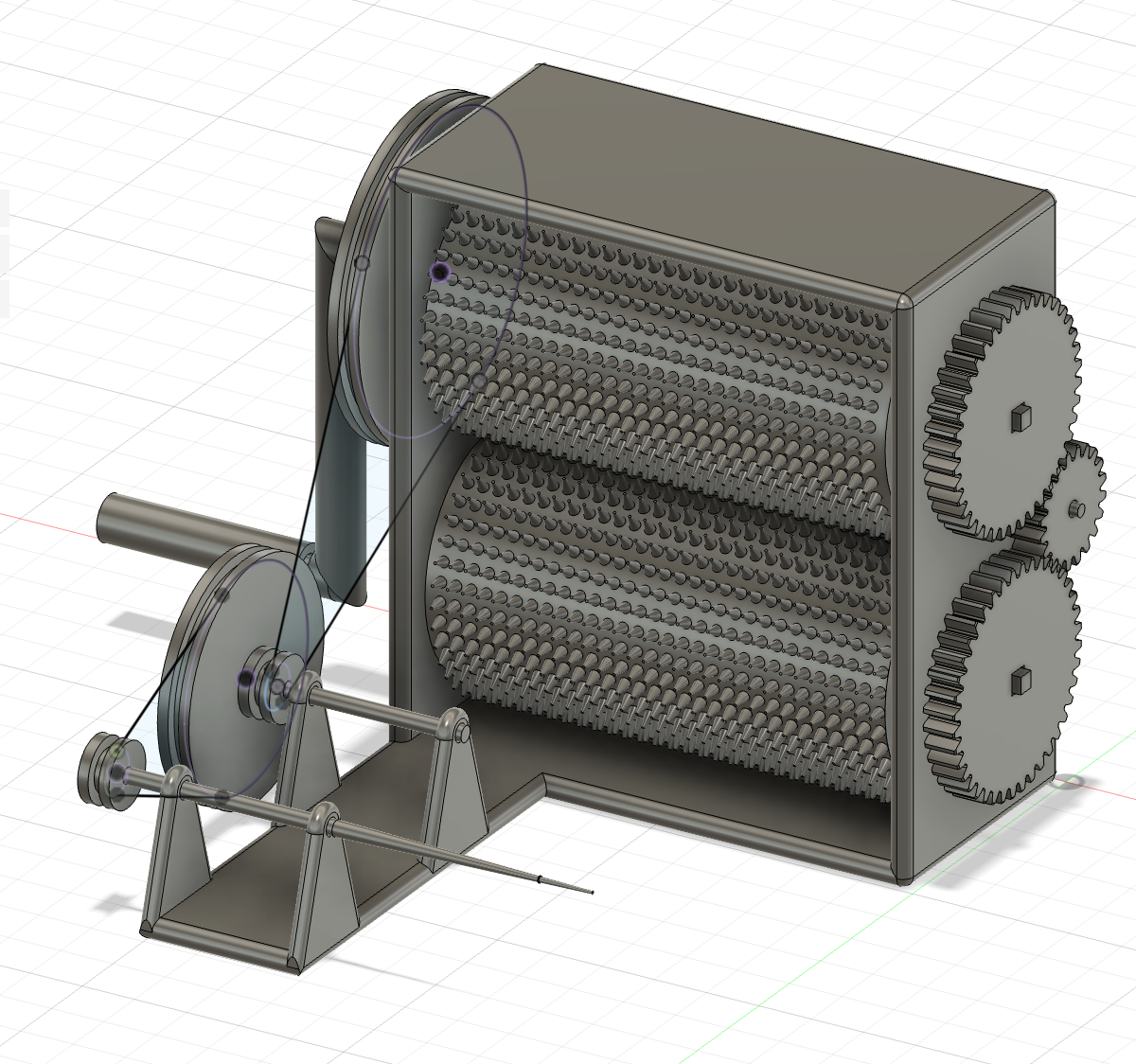
The idea behind these designs was centered around the threaded hollow tube and the inside piece. Because of the threads, as the inside piece was pulled forward by the spool/handle’s rotation, it would spin around and create yarn. In the photos above, one can see the rack that (contingent on the handle’s rotation) would pull the center piece forward. However, upon reflection on the design, I realized that this shift in rotational direction was entirely unnecessary. By eliminating the tube and replacing it with a more traditional flyer, my next prototype became more realistically functional. This prototype also made additional improvements on the two above by streamlining the crushing, carding, and combing attachments, and reducing the size of the entire product (to make its tabletop use more convenient). Shown below are photos of the model, as well as photos of the 3D/resin printed version used for testing:
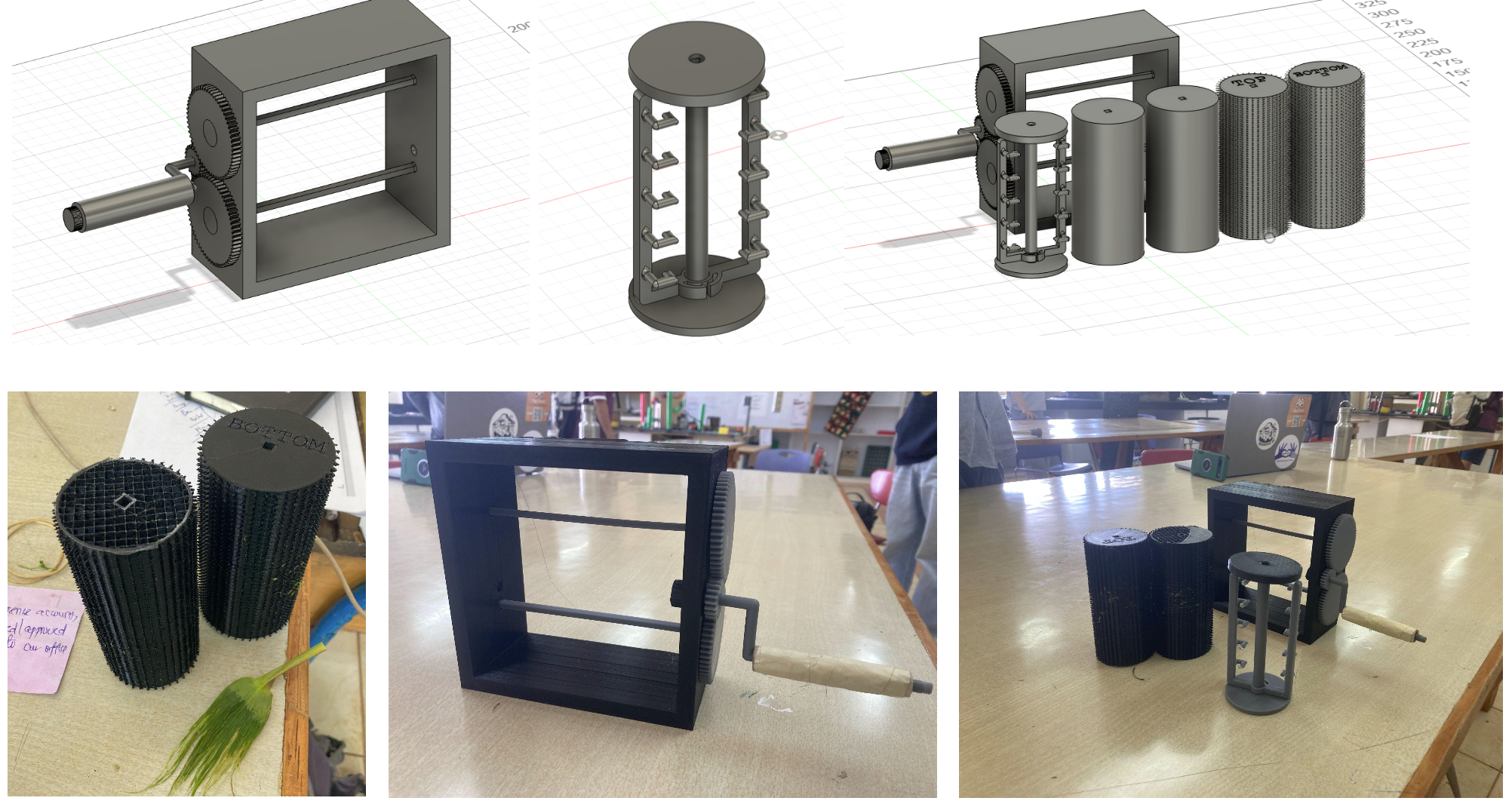
The goal of this design was to facilitate the process of extracting natural fibers, carding, and spinning by combining the relevant functions into a single product. Ideal natural materials to use with the design would be sugarcane waste, sisal, or other highly fibrous plants, as the prototype has not yet been fine-tuned to accommodate more fragile plant material (e.g., water hyacinth).
The design itself was intended to be flexible, consisting of a main base/body and several different attachments for each function. Large, smooth cylinders are available for crushing natural materials, while more rough-textured ones allow for carding and separating fibers. Finally, a flyer and spool make up the third possible attachment combination, providing textile artists with the means to spin their refined fibers.
The axles these attachments rest on are also removable to aid in the process of setting up different functions for the design. All moving parts are secured with screw-on caps. Another potential improvement to this prototype could be making it symmetrical so as to allow for easier use by those who are left-handed.
Upon testing, it was found that the different attachments proved effective for isolating fibers, but that the flyer hooks would need to be closed further in order to facilitate spinning. However, I still wanted to try to create the design out of waste materials. After several failed attempts to use aluminum cans, I created a cutout on Adobe Illustrator for an assembleable cardboard version:
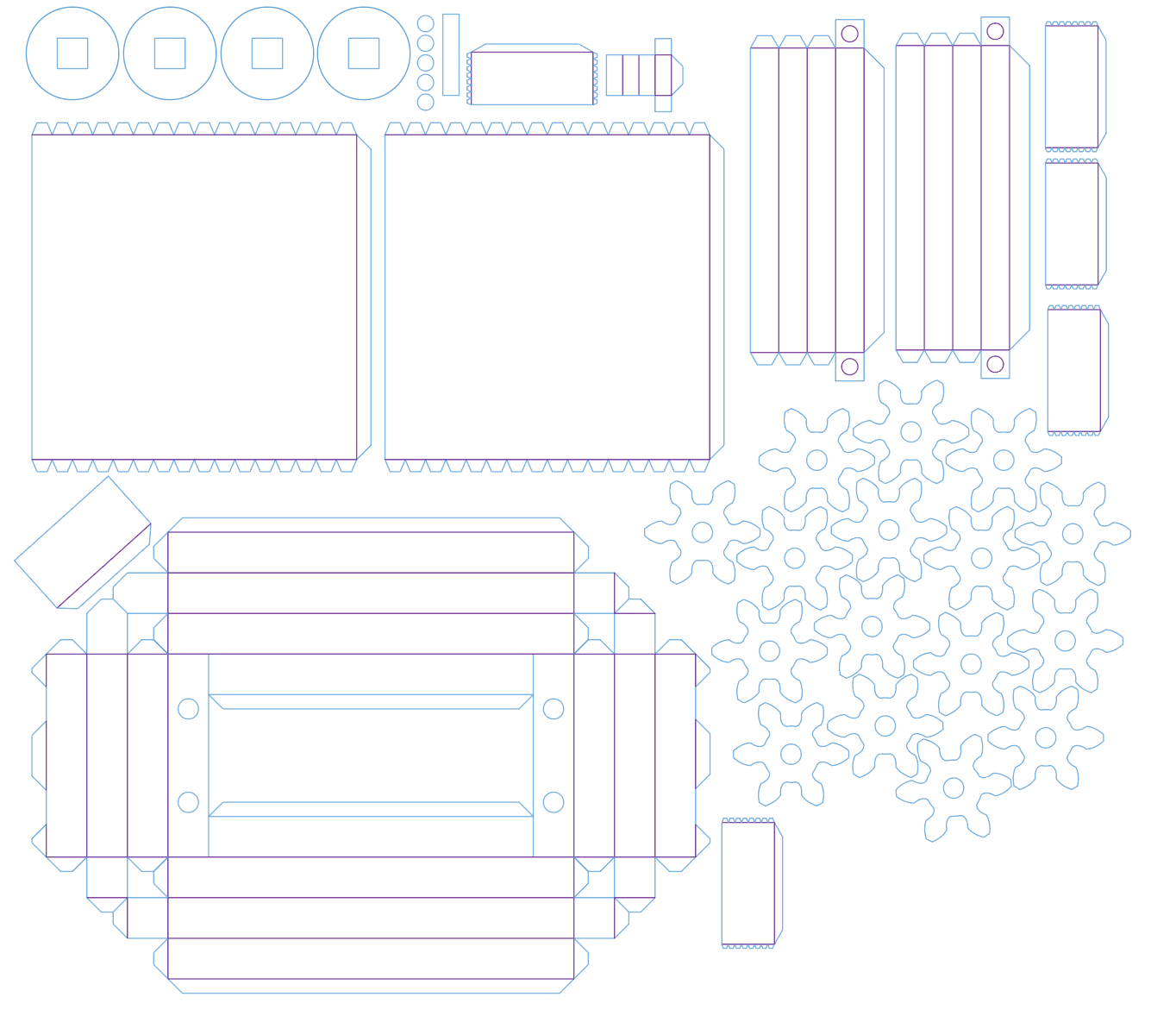
While more environmentally friendly, this version was a nightmare to assemble and barely worked. After spending several classes trying to design a product made out of waste materials, I decided to take a step back and focus on creating a design that worked well. This ended up being a smaller, book-charkha-inspired, 3-D printed design: